
Lee County Court Records After Arrest
Lee County court records after a jail arrest begin with a simple split: booking information is not the same thing as a filed court case. The Lee County sheriff's weekly JailTracker commit PDFs can show a person's name, SWVRJA Duffield location, booking date, statute line, offense text, and court in parentheses. Those reports help identify the arrest and jail side of the event. The formal criminal case is checked through Virginia court systems or through the Lee County Circuit Court Clerk, depending on which court has the charge.
The Lee County Commonwealth's Attorney is the local prosecutor, not a district attorney. The office states that it prosecutes crimes, investigates alleged crimes with law enforcement, files criminal charges, and presents evidence to grand juries that may lead to indictment. That charging role is why court records after an arrest may differ from the first booking charge. For custody and booking fields, use the Lee County jail inmate records page; for booking-photo issues, use the Lee County jail mugshots page.
The strongest first source for the court side is the Virginia court case information hub. The Virginia Case Status and Information page links users to statewide and court-level search tools, while the Lee County Circuit Court Criminal Division page explains felony jurisdiction, misdemeanor appeals, fines, costs, and criminal case information for the circuit court.
Find Lee County Court Records
Start with the court search channel that matches the charge shown in the jail record. Lee County commit reports may list a court such as Lee Circuit, another circuit court, General District Court, or JDR. Felony cases and some misdemeanor matters can move into circuit court, while traffic and many misdemeanor cases often begin in General District Court. Juvenile and domestic relations matters may follow a more limited public-access path.
- Open the Virginia court case information hub and choose the search system that fits the court level.
- Use Lee County or the court locality shown on the jail charge line. Some commit reports include courts outside Lee County.
- Search by defendant name first. Add a case number or hearing date if the name is common.
- Open the matching criminal or traffic case and review each charge, case number, hearing, and status entry.
- For old, sealed, or missing records, contact the Lee County Circuit Court Clerk or the correct district court clerk.
The image below comes from the official Virginia court case-information hub, the statewide starting point for many Lee County court records after arrest.
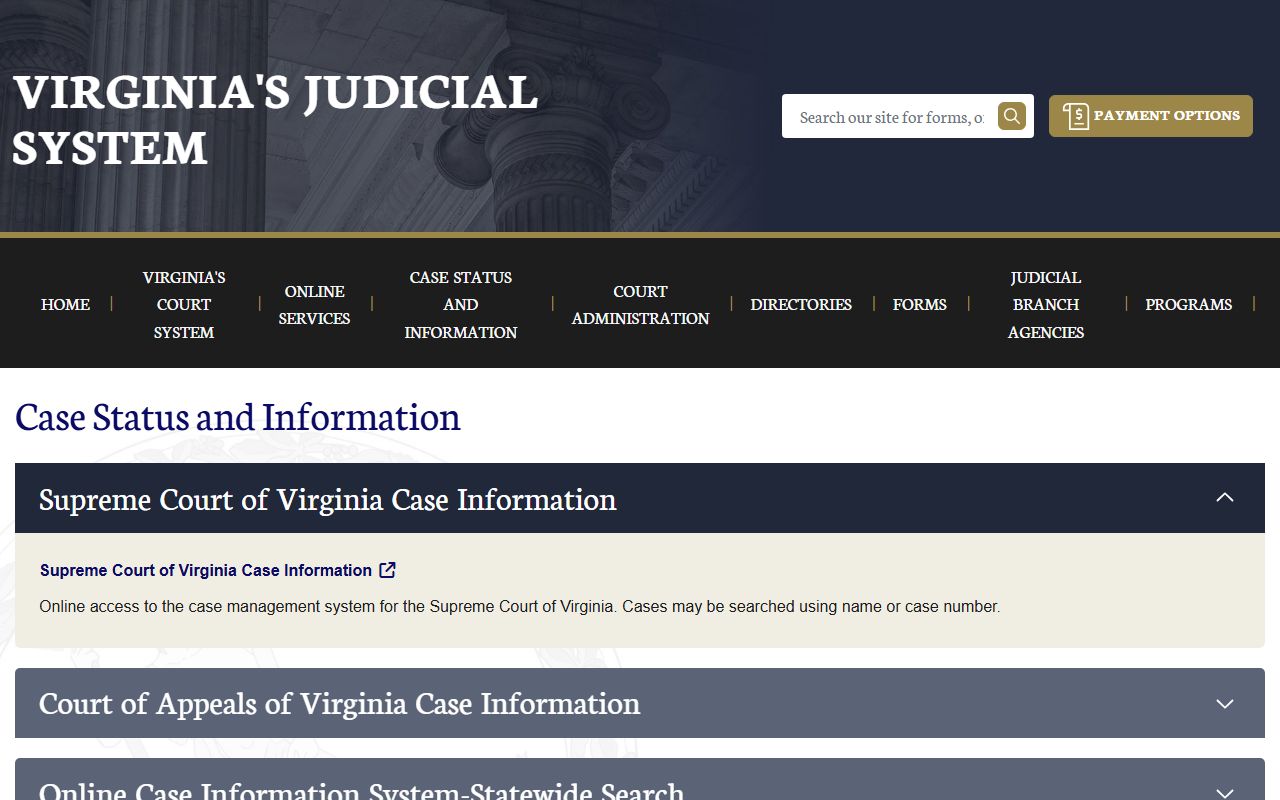
Use the statewide hub to reach General District, Circuit, JDR, and OCIS search paths before calling a clerk for records that are not visible online.
| Field Label | Type | Required | Notes |
|---|---|---|---|
| Locality | Dropdown | Yes | Choose Lee County or the court locality shown in the charge line. |
| Name | Text | One search path | Use full spelling where possible. Middle names help with common names. |
| Case Number | Text | One search path | Use if copied from court papers, a warrant, or a roster profile. |
| Hearing Date | Date | One search path | Useful when a name returns many cases. |
| Court Type | Dropdown or tab | Varies | General District, Circuit, JDR, and OCIS coverage differ by court and case type. |
Lee County Charging Documents
The arrest starts the custody path, but a charge reaches the court record through a charging paper. In Lee County, the Commonwealth's Attorney may file criminal charges or present evidence to a grand jury. The Circuit Court Criminal Division handles all felony cases, misdemeanor cases that begin by grand jury action, and misdemeanor appeals from General District and JDR courts. That means a booking charge can be only the first public clue, not the final version of the case.
The Lee County Commonwealth's Attorney homepage is a useful source for the prosecutor's role in filed charges and grand-jury cases. The image below links to the official Lee County Commonwealth's Attorney homepage.

When a court record mentions an indictment or amended charge, read it as a prosecutor or grand-jury step, not as a new jail booking by itself.
| Document | Who Uses It | Common Lee County Use | What To Check |
|---|---|---|---|
| Complaint | Officer or prosecutor | Often tied to the first charge path after arrest | Charge text, statute, date, and issuing court. |
| Information | Prosecutor | May reflect a formal prosecutor filing | Whether the charge changed from the jail report. |
| Indictment | Grand jury | Used for felony cases reaching Circuit Court | Count number, felony level, arraignment, and later plea or trial dates. |
Lee County Charge Status
Charge status tells where a filed case stands. It is one of the most important parts of Lee County court records after a jail arrest because a person can be booked on one phrase, charged in court under another phrase, and later have the charge amended, reduced, dismissed, or resolved by plea. A status line should be read with the court name and hearing history, not alone.
| Status | Plain Meaning | Why It Matters |
|---|---|---|
| Pending | The case has not reached final disposition. | Future hearings, bond terms, and custody status may still change. |
| Amended | The charge text, count, or statute changed. | Compare the court record to the original booking charge before relying on either one. |
| Reduced | The charge moved to a lesser offense or level. | A felony booking line may not remain a felony court outcome. |
| Dismissed | The court ended that charge without conviction. | Other counts, costs, or related cases may still exist. |
| Nolle prosequi | The prosecutor chose not to proceed at that time. | It is not the same as an acquittal and should be read with counsel or clerk guidance. |
| Convicted | The case ended in a guilty plea or finding. | Sentencing, fines, probation, or transfer to another custody system may follow. |
Lee County records can also show probation violation charges under Virginia Code section 19.2-306 in jail commit reports. A probation violation may involve a revocation hearing and may have a different bond posture than a new misdemeanor or traffic charge.
Bond After Lee County Arrest
Bond information belongs in both the jail and court context, but it must be checked carefully. The research did not locate official Lee County-specific bond-posting instructions on the sheriff or SWVRJA pages. The safer path is to locate the person in SWVRJA JailTracker or the weekly commit PDF, call SWVRJA Duffield at 276-690-9550 or 276-431-8000 to confirm custody, then check the court case for bond orders, hearings, and charge status.
| Bond Term | How It Works | Lee County Caution |
|---|---|---|
| Personal recognizance | Release based on a promise to appear and obey conditions. | Conditions may still restrict travel, contact, or conduct. |
| Unsecured bond | An amount is set but not paid up front unless conditions are breached. | The case remains active even if no cash is paid. |
| Secured or cash bond | Money or surety must be posted before release. | Confirm the correct posting office and exact bond status first. |
| No-bond hold | Release is not available unless a judicial officer changes the order. | A jail record may still list charges even though bond cannot produce release. |
| Detainer or hold | Another agency or case is keeping the person in custody. | A local bond may not clear the custody hold. |
Court fines and costs are not bond. The Lee County Circuit Court Criminal Division accepts payments for assessed criminal fines and costs, including cash, checks, money orders, certified funds, and card payments with a convenience fee, but those payments are separate from release before trial.
Lee County Warrants and Court Records
No official Lee County sheriff active-warrant search was located in the research, and SWVRJA does not publish a separate warrant-search portal. Warrant information must be checked through the sheriff's office, the relevant court, or a booking record after the warrant has led to custody. Useful channels include the Lee County Sheriff's Office at 276-346-7753, sheriff non-emergency at 276-346-7777, the Lee County Circuit Court Clerk at 276-346-7763, and Virginia court case searches.
A warrant can become a court and jail record when an officer arrests the person, the jail records the booking date and charge or hold, and the court schedules a hearing. Bench warrants and capiases often arise from failure to appear or failure to follow a court order. A search warrant is different. It authorizes a search, not an arrest by itself.
Note: A warrant-based booking may show on the jail report before all court details are visible online.
Charges vs Convictions
A charge is an accusation in a court record. A conviction is a final court result based on a guilty plea, guilty finding, or verdict. Lee County court records after a jail arrest should never be described as proof of guilt unless the record actually shows a conviction. This is especially important when a jail report lists a charge from the booking stage and the court later reduces or dismisses it.
| Point | Charge | Conviction |
|---|---|---|
| Stage | Accusation filed or listed in the case. | Final guilty result by plea, finding, or verdict. |
| Proof | Based on probable cause or charging authority. | Requires the legal standard for a criminal judgment. |
| Record Use | Shows what was alleged and how the case started. | Shows the offense that resulted in judgment. |
| Can Change | May be amended, reduced, dismissed, or not pursued. | Can still be appealed, sealed, or otherwise affected by later court action. |
Sealed Lee County Arrest Records
Virginia sealing law affects what the public can see after a court record or arrest record becomes restricted. Virginia Code section 19.2-392.5 describes the effect of sealing records. A sealed record is generally treated as not public, which can limit release of court, arrest, and related law-enforcement records. Eligibility and procedure depend on the case, so a clerk or attorney is the safer source for case-specific direction.
| Point | Sealed | Expunged |
|---|---|---|
| Public View | Hidden from routine public access when the statute applies. | Historically treated as removal from public record access. |
| Agency Access | Limited access may remain for specified lawful uses. | Access depends on the order and controlling law. |
| Best Source | Court order, clerk record, and Virginia law. | Court order, clerk record, and Virginia law. |
| Practical Effect | May stop routine release of the case or related arrest information. | May require agencies to restrict or remove public-facing record access. |
Important: Lee County Inmate Population is not a consumer reporting agency, and court records cannot be used for FCRA-covered screening decisions.
Restricted Lee County Court Records
Virginia public-access law supports access to many adult criminal records, but the research identifies several limits. Virginia FOIA section 2.2-3704 requires requests to identify records with reasonable specificity and generally gives public bodies five working days to respond. Virginia Code section 2.2-3706.1 covers criminal incident information and investigative-file limits, including victim protections and law-enforcement restrictions.
Juvenile matters, sealed charges, expunged or sealed records, victim-identifying material, certain ongoing felony investigations, and security-sensitive jail data may be withheld or delayed. The same arrest event can have public jail fields, public court fields, and restricted investigative material. For that reason, Lee County court records after arrest should be checked by source: SWVRJA for custody and jail intake, the sheriff for sheriff-created arrest records, the court clerk for case files, and the Commonwealth's Attorney for prosecution records that are actually subject to release.
Note: Virginia VINE is useful for custody and case notifications, but it is not a replacement for the court case record.